Sorry I didn’t continue sharing my Suite101 articles here. I kind of got sidetracked when I made a visit back home to meet my nieces when they were arranging to sell all the property– the home they grew up in, and the next-door (down the hill) home that their mother, my sister, and I grew up in. It was essentially my last visit back home, because the old homeplace doesn’t exist for us anymore as a place where we can meet. I guess this was what sparked my reminiscing through writing children’s picture books.
The first one, published in July, had to be “Little Girl Again” with the text being the poem by that title that I wrote about being my mother’s caregiver during her Alzheimer’s, around 30 years ago now.
Following close behind that first book, in August I wrote “Aunt Della’s Teacakes” about my Aunt Idella, my dad’s sister, who lived in the other side of our old farmhouse and also “Mama’s Quilts” from the poem by that title I had written about the quilts my mother made from old scraps of fabric cut from clothes we had worn in the past.
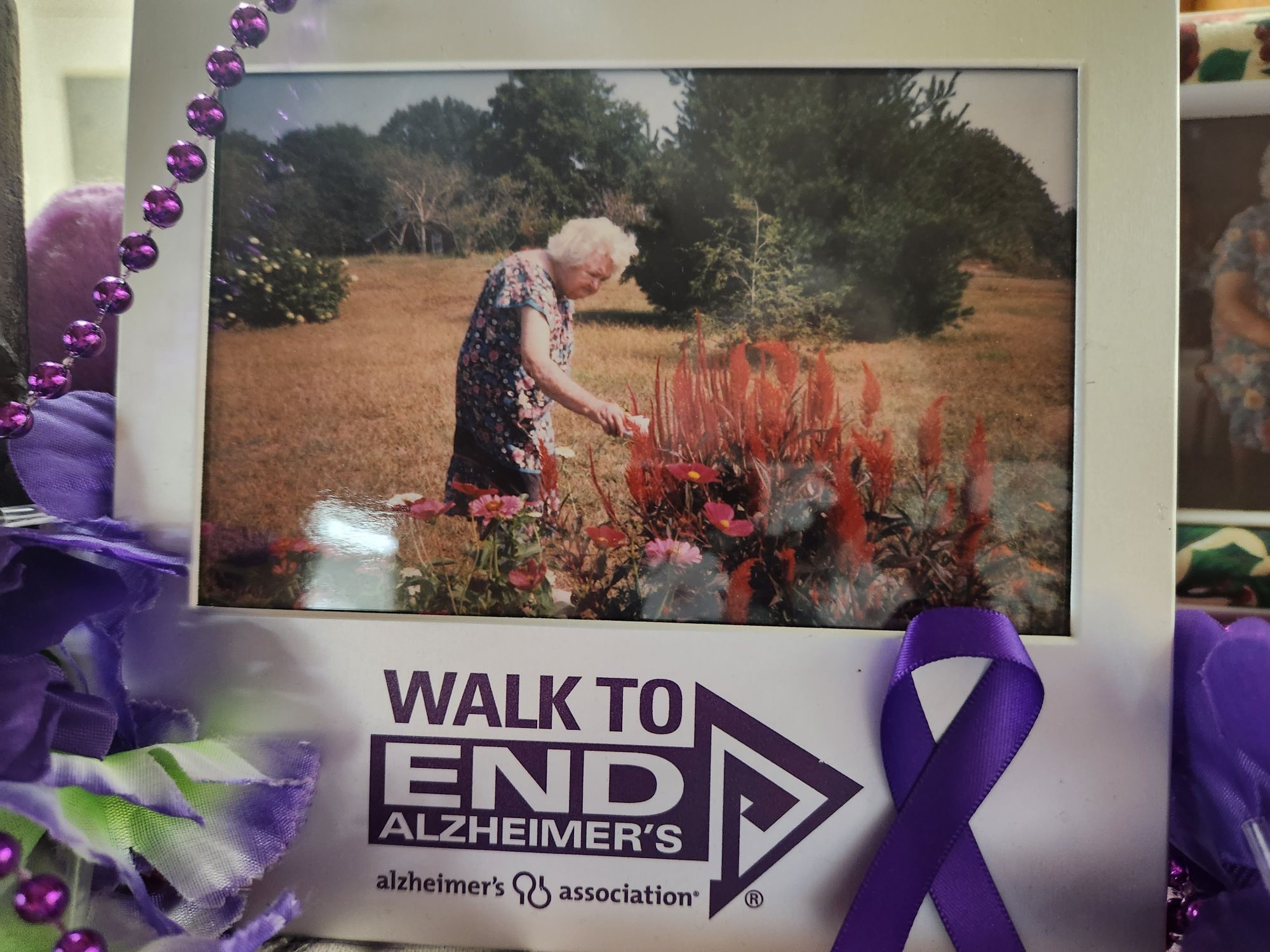
Then in September came “Daddy Farmer” about my hard-working farmer dad, and “Mama’s Biscuits” about my mother’s delicious baking and how that changed as she got older. October brought memories of “Picking Huckleberries on Ross Mountain” and “Flowers for Mama” which ended up with the purple flower I hold high in memory of her in the Alzheimer’s Association’s Walk to End Alzheimer’s.
I didn’t have much time at our November 1 Walk to read, but I was asked to speak during the opening ceremony, and I read all of “Little Girl Again” and then the last few pages of “Flowers for Mama”. It was my 28th consecutive year walking in memory of my mother.
In November I wrote “The Library Upstairs” about an old antique bookcase full of books upstairs in our old farmhouse, and I wrote “Mama Canned”, inspired by all the canning of fruits and vegetables on our farm that my parents had worked so hard on every summer and into the fall.
Then in December, it was “Christmas Past”, with the title from a poem I’d written, though I didn’t include the poem until the end and instead wrote a narrative describing our Christmases when I was growing up back home, 1955-1973 or so.
They all are available in paperback and Kindle eBook from Amazon and in hardback from Barnes & Noble, Books-a-Million, and many other online bookstores. All royalties go to the Alzheimer’s Association through my Walk to End Alzheimer’s. Enjoy, and Happy New Year!
Originally published in two parts by Suite101 in 2004 when I was their Alzheimer’s Disease topic editor
There wasn’t a lot my mother could still do at the time when returned home to take care of her. She could still walk, and on nice days we tried to take at least one good walk outside. She could no longer fold clothes or make beds, though she still tried, she just wadded up clothes, and pulled the sheets back instead of up. She did enjoy helping with the dishes. She had to ask where each piece went, but she loved to dry and put away the dishes. She called this “washing dishes”, and she thought they weren’t washed unless they were dried and put away. Once when she didn’t help and I left them in the drain rack, she complained later “That girl didn’t wash the dishes!”
She loved to listen to soft music, and she would usually fall asleep in her chair while she was listening. Though TV became too disturbing to her, there were videos we could watch, old family-type TV series, like “The Waltons” and “Little House” were favorites. She usually enjoyed it when I read to her from magazines or books, though I had to pick just the right kinds of stories.
I tried to provide an atmosphere that was cheerful and neat. The old house needed some new floor tiles, wallpaper, and paint, so I did some of that early in my stay there. Not too much, though, because it began to be disturbing to her. I placed plants everywhere inside and on the front porch, and I planted flowers everywhere outside so that we could see them when we took our walks. I hung birdfeeders on the old clothesline pole and attached some to windows with suction cups, and she enjoyed watching the birds. Often the birdfeeders attracted squirrels as well, and she really enjoyed watching them.
My mother loved to walk outside. When she was feeling well and the weather was nice, sometimes she would want to go walking several times during the day. I thought it would be nice to have some flowers to enjoy all along our walking path. I planted flowers around the back of the house so that she would see them as soon as we walked out of the back door. She usually wanted to walk over to the clothes line where the bird feeders were and see the birds, which flew away as we approached. Then she would want to go check on the kittens down at the shed or my brothers animals (horses, goats, pigs, or whatever he was keeping there at the time) in the pasture near the old barn. Then we would walk around the house, stopping to see the roses along the side of the house if they were blooming. If it was time to go to the mail box, she would walk about half-way down the drive-way with me and say “I’ll wait here” because she was afraid to get close to the road. Then we would stop at the circular flower bed in the front yard, where there were tulips and daffodils in the spring, poppies and zinnas in the summer, and mums in the fall. We would walk by an evergreen tree that she’d planted that was having a hard time, never grew much and was drooping at the top, and she would reach out to it and say “poor little tree.” Then we would walk across the yard and up a gradual slope on the way to the garden, viewing a rectangular flower bed with more of the same kinds of flowers, and she would usually reach out and touch the taller ones and say how pretty they were. The little hill up to the garden was the hardest part of the walk for her, just a gradual incline, but often she would be out of breath when we reached the top. That’s one reason I wanted to put the bench in the garden.
That was one of my mother’s favorite places. She loved to sit there and rest before we walked back to the house. The bench was under two old peach trees that were kind of growing into each other at the top, and it made a perfect shade, a cool spot to rest on hot days. I planted impatients, coleus, and caladiums, and even if the hot sun and dry weather got to the other flowers, these under the biggest peach tree thrived. My mother would reach out to the flowers, touch them, and talk to them. And sometimes we would have a visit from a cat (sometime the cat would go on the walk with us) that would seem to enjoy the rest in the shade just as much as we did.
From the bench we could see the small garden, where I had tomatoes, peppers, squash, okra, and beans growing. We would sit on the bench and talk about the garden, which I hoped would make Mama feel more at home because she had farmed and had big gardens all of her life.
When my mother had rested enough or was getting tired of sitting there, we would walk on around, past the garden, and down the drive way that connected my sister’s back yard with ours. We would walk past a fig bush that was producing wonderfully, and most of the time we would stop and pick some, because Mama loved figs.
Before going back in the house, we would look at the flowers just outside the back door again. The pansies thrived there. And there were a few miniature rose bushes that were doing really well, too. Other than roses, I think my mother liked the big yellow pansies with the black faces best.
Most of the time when we got back in the house, my mother was ready to have a glass of water and then sit in her chair to take a nap. But sometimes, if she was feeling really well and it was a nice day that wasn’t too hot, she would want to go out to the front porch for a while. My mother loved to sit on the front porch, and most of the time she chose to sit in the swing. She would talk about the cars that passed on the highway, and things she saw (or thought she saw) in the yard, or across the hay field, or up the hill at my brother’s house. We would talk about the flowers I was growing all over the porch, and sometimes she would say “so pretty.” The six hummingbird feeders gave her something else to watch and talk about as our little visitors would fly in and out among the hanging baskets. Even on days when it was a bit too hot for walking, or when it was raining a little, the front porch was a nice cool place to sit, and a nice place for family to visit. Somehow it never seemed to confuse my mother as much when people visited on the front porch, and she was usually wearing a smile whenever she sat in that swing.
My mother had always enjoyed reading, when I would ask if I could read to her, she would usually say “yes”. She would tell me how she used to love to read, but that she “just couldn’t see how to anymore”. My sister had subscribed to a large-print Guideposts for her, thinking maybe she could still read, but once when I asked her to try to read, all she could make out were the articles, A, an, or the, and only when they were the extra large-print in titles.
I read to her from Reader’s Digest and Guideposts, and sometimes the stories would make both of us cry. Sometimes she thought the people in the story were actually there, or that I was reading a letter from someone to her, or even that I was telling her a story about myself. I also read to her from Country, Country Extra, Reminisce, and Birds and Blooms all published by Reiman Publications (P.O. Box 991, Greendale, WI 53129-0991). Even after she could no longer follow a story, she enjoyed the beautiful pictures in these magazines. Birds and Blooms even has a “Ready for a Walk?” section, so we could pretend we were walking outside and seeing flowers, birds, and butterflies even when the weather wouldn’t permit our real walk.
I read several children’s books to my mother, too. All the Places to Love by Patricia MacLachlan (HarperCollins, 1994) was a picture book about living in the country and the love of family, and she enjoyed this, as she did Home Place by Crescent Dragonwagon (Macmillan, 1993). I read some from a book about Laura Ingalls Wilder, too, and she enjoyed it for a while. I think she might have enjoyed me reading from the actual Little House books, because she always enjoyed the series so.
It didn’t take me long to learn that we could no longer watch the evening news or any of the murder mysteries my mother used to enjoy. My sister taped all of the Little House on the Prairie series for us and she kept an eye out for every movie that might be suitable. My niece taped all of The Waltons which my mother especially enjoyed, because the Depression years were the ones she could remember. Every time I went shopping, I’d buy more movies, and I ordered everything I could find that I thought she would like. I collected practically all of the Shirley Temple movies, and my mother said she enjoyed seeing “that little girl who likes to sing and dance.” Shirley Temple was her favorite child star, and Jessica Tandy was her favorite older star; She enjoyed Driving Miss Daisy and Fried Green Tomatoes.
Another favorite was Anne of Green Gables. A Home Health Aide even got in on bringing us some of those movies to borrow, and I ending up collecting most of them on my shopping trips. I also found an old Lassie movie that my mother enjoyed.
Sometimes it would take us a week to watch one movie. We watched movies only after supper each evening and until bedtime, while we sipped on a cup of chamomile tea (which would sometimes help her sleep better). The only time we would watch movies much in the daytime was around Christmas, when we watched holiday movies. My mother’s attention span was short, and she would get sleepy and seemed to need frequent naps. After a half hour to an hour of a movie, she was ready for bedtime, and calmly went to bed, unless there happened to be something in the movie that upset her–and that happened at times when I least suspected it.
Our movie times were special. Often she held my hand as when we were watching a movie. Once she told me it was so she wouldn’t be scared. She couldn’t understand that it was all make believe, and often as I got her ready for bed, she would be so concerned about those people we left in the living room.
When nothing else would work, music would usually calm my mother. I had a cassette player (and then later a CD player) just on the other side of the wall in the next room from where she sat. Some favorites were Guitar by the Sea, Late Night Sax for Lovers, and Hymns by the Sea. Only instrumental would work; She became disturbed by any vocal music, thinking that someone was actually in the house, singing. And even the instrumental music had to be very calm, with no loud surprises. I think that she would have liked most of the music on my Web site.
Discussion of activities for Alzheimer’s patients comes up pretty often on the Alzheimer list, so that’s a good place to find help with activities. You might search the archives for past discussions using “activities” as the search term. The books recommended below will also help.
I will try to cover other suggested activities that may be used with Alzheimer’s patients in my next article.
Things to Do: Activities for the Alzheimer’s Patient, Part 2
People with Alzheimer’s need something to do so that they can continue to feel a sense of accomplishment and self-worth for as long as possible. They need exercise and to enjoy doing something. They need to be able to continue favorite hobbies, artwork, music, or whatever they have enjoyed in the past for as long as they can.
Of course the person with Alzheimer’s, depending on the stage of the disease, may not be able to participate in all activities, and the choices will decrease as the disease advances. “As the disease progresses, options become more limited, but the ability to enjoy life remains.” (There’s Still a Person in There, p. 243.)[1]
It doesn’t have to be a lot of activity. If they do just small things, and only a little at time, whatever they can do may help. “It often seems that getting the body moving helps cheer a person up…Perhaps she can peel only one potato today. Tomorrow she may feel like doing two. Perhaps she can spade the garden. Even if she spades it for only a few minutes, it may have helped her get moving. If she stops a task after a few minutes, instead of urging her to go on, focus your attention on what she has accomplished and compliment her on that.” (The 36-Hour Day, p. 151) [2]
The following activities are suggested in Practical Guide for Caregivers, compiled by Tamara Johnson which was distributed by the presenteresentor to those of us who attended a conference in Huntsville, AL several years ago:[3]
Art: Clay – Use modeling clay and make objects or animals. Water colors or crayons – free-style water-color/crayons Drawing – Freehand drawing, copy picture, trace a picture, use a template Composite Picture – Cut out favorite pictures from a magazine. Use a common theme, as food, people, pets, antiques, etc. Picture may be decorated with buttons, yarn, etc. Cards – Make cards to send to loved ones on special occasions or any time.
Gardening: Root from cuttings/seeds, transplant, bonsai trees or other miniatures, make scrap books with dried wild flowers.
Music DVDs: tapes/cds, videos/DVDs, sing-a-long, choir-hymns, drums or any musical instrument
Food: Cut out cookies from dough, decorate cookies, cakes, microwave baking, instant pudding, frozen deserts, “mud”: chocolate pudding and cookie in clean clay flower pot and stick plastic flower on top
Other: Write letters, make cookbooks, photo albums, and memory albums.
Caution must be taken to not try to make the person do more than they can do or continue an activity longer than they wish. “Whenever you or someone else initiates an activity for a person with dementia, you must walk a fine line between meaningful activity and overstressing the person. Move at the confused person’s pace. Never let an activity become a test of her abilities; arrange things so that she will succeed. Having fun should be more important than doing something correctly. Stop when the person becomes restless or irritable.” (The 36-Hour Day, p. 163.) [4]
Activities for the Alzheimer’s patient are an important part of caregiving. Life needs to be enjoyable, and indeed it can be. Caution, however, must be exercised in order to make sure that the activity is enjoyable and not overtaxing the Alzheimer’s patient.
1. Castleman, Michael, Dolores Gallager-Thompson, and Matthew Naythons. There’s Still a Person in There: the Complete Guide to Treating and Coping with Alzheimer’s. New York: Berkley Publishing Group, 2000, p. 243.
2. Mace, Nancy L. and Peter V. Rabins. The 36-Hour Day: a FAmily Guide to Caring for Persons with Alzheimer’s Disease, Related Dementing Illnesses, and Memory Loss in Later Life. Baltimore: Johns Hopkins University Press, 1999, p. 151.
3.Practical Guide for Caregivers, compiled by Jamara Johnson. Hartselle, AL: Hartselle Medical Center. (Presented at “The Gift of Cargiving” conference on Sept. 20, 1997 at Trinity United Methodist Church, Huntsville, AL, in association with the North Alabama Chapter of the Alzheimer’s Association).
This article was originally published May 8, 2003 at Suite 101 when I was an Alzheimer’s disease topic editor for them.
The weather we are having in the Southeast and the recent earthquake here in Alabama have me thinking about my year as my mother’s caregiver. As always in this state, there were plenty of tornado warnings and watches, but we also had one unusual weather-related even when the destruction of Hurricane Opal came all the way up into north eastern Alabama where we were.
My mother slept through that night while I listened in bed to a small radio through earphones. I stayed awake all night as the wind whistled around the old farm house and downed trees all around. I kept thinking I needed to get my mother into a more central location in the house, but I didn’t want to waken her and risk the confusion that would be sure to result. So she and I both stayed in bed, and while I worried, she slept like a baby. Any other night she would have been up wandering through the house.
There’s a fine line between keeping an Alzheimer’s patient safe and keeping him or her calm during a storm. Yes, keep them safe, but try to minimize talking about the storm if possible. If the electricity goes out, they might even enjoy, as my mother seemed to, a return to the candles or oil lamps of their childhood. Even if the electricity remains on, they might find comfort in turning the lights and television off and enjoying candlelight. The old farmhouse with its minimal wiring often popped during an electrical storm, especially when I was a child. My mother turned off everything and unplugged the television, so I did this for her as well when she became my “child” to protect from the storm.
To take the minds of the caregiver and the patient alike off the storm, it might be a good time to tell a story or reminisce. If the lights remain on, it might be a good time to read to the patient. A fearful time can thus be transformed into a cozy and enjoyable story time.
Yes, do keep a source of news available and keep your patient in a safe area of the house. Or if they are sleeping as my mother was on the night of Opal, be ready to move them to a safer place if needed or even to a shelter if necessary. Always keep first aid supplies on hand, as well as bottled water, canned food, and candles in case you have to survive for a time without electricity.
A page at Alzheimer’s Outreach lists tips for Natural Disaster Safety. Among them include having a disaster plan, making neighbors aware of the AD patient’s special needs, and having the patient wear an identification bracelet, as well as keeping stocked with extra food, medicine, water, batteries and other necessities.
An article at About.com asks “Are You Prepared?” and lists twelve steps in creating a disaster plan which also includes taking first aide and CPR classes.
May we all be safe and spared tornados, hurricanes, earthquakes and other natural disaster, but may we also be prepared to keep our Alzheimer’s patients as safe and calm as possible just in case.
This article was previously published in Suite101 on October 1, 2001.
Alzheimer’s disease involves much more than memory loss. Most of us tend to be a bit forgetful as we grow older, especially with our hectic lifestyles and our wearing of many hats at work and at home. We have to write appointments on our calendar, to keep lists for shopping and other to-dos, and still we may occasionally forget a meeting, appointment, assignment, or deadline. We may have trouble finding the right word or remembering a person’s name. All of this, as well as misplacing keys and other things, are examples of normal forgetfulness that we all experience.
The Alzheimer’s Association has listed ten warning signs of Alzheimer’s that are common to Alzheimer’s and other dementias:
1. Memory loss that affects job skills. 2. Difficulty performing familar tasks. 3. Problems with language. 4. Disorientation to time and place. 5. Poor or decreased judgement. 6. Problems with abstract thinking. 7. Misplacing things. 8. Changes in mood or behavior. 9. Changes in personality. 10. Loss of initiative.
We may experience one or more of the above from time to time, but the person with Alzheimer’s has all or most of the above symptoms at times, in varying degrees according to the stage of progression of the disease. Occasional forgetfulness is normal, but frequent forgetfulness and unexplained confusion at work may be a signal of Alzheimer’s or another dementia. We all may forget at times when performing familar tasks, for example letting something we are cooking burn. But the person with Alzheimer’s might forget to serve, or to eat, a complete meal. It’s normal to forget where we’ve parked the car at the mall, but the person with Alzheimer’s may forget how to get back home after shopping. We may make the mistake of not bringing a sweater or coat on a cold day, but the person with Alzheimer’s may be totally unaware of the weather and wear something completely unapproapriate for the season or the occasion. Balancing a checkbook may be challenging for some of us, but for the person with Alzheimer’s it may be impossible to recognize numbers, much less to do mathematical calculations. All of us experience a broad range of emotions, and our personalities may change as we age, but the person with Alzheimer’s may experience rapid mood swings and dramatic personality changes for no apparent reason. We all grow tired of our activities at times, but the person with Alzheimer’s may totally lose interest in something previously enjoyed. The Alzheimer’s Association advises “If you have several of these symptoms, you should see a physician for a complete examination.”
The diagnosis of Alzheimer’s today is not the hopeless forecast that it has been in the past. There are new medications that will postpone the more advanced symptoms and allow the patient to function more fully. I am amazed at all the early-onset Alzheimer’s patients I’ve met on the Internet are able to accomplish with their Web sites and online support groups. And there is so much hope for the future, hope for newer and better medications, better methods of diagnosis, and even preventative measures. Recognizing the symptoms and having getting that complete examination are all important as the earlier the diagnosis, the greater the hope, and the better both patient and caregiver can be prepared for the approaching storm.
“Ten Warning Signs” from the Alzheimer’s Association Web site. http://www.alz.org/alzheimers-dementia/10_signs
I was thinking about the early days of the internet when so many of us had web sites we called “personal homepages”. So many of those ceased to exist when Geocities went away. I decided to do a search asking if there is anything similar to Geocities these days. Someone else had asked that question on Reddit, and someone answered yes, Neocities.
I hope that others will create sites there about Alzheimer’s/dementia and in memory or honor of their loved ones like in the old days, like 1996-2006.
I also found through WayBack Machine 34 articles of mine from when I was an Alzheimer’s topic editor at Suite101 in 2001-2004. I copied and pasted them into emails to myself. I want to add them to my web site and post them here, maybe even brimg them up to date a bit and publish them in a book.
It’s been a good day. By the way, my mother passed away 29 years ago today.
Although it was early for me back then, I had to go to bed when my mother did, sometimes as early as 6:30. I never knew how soon she might be up wandering the house. And I was usually so exaustef that I could fall asleep quickly.
These days I’m wanting to go to bed at 6:30. I get up at 4:00 to do my knee exercises (had knee replacements in 2020 and 2022) before getting ready for work.
Yes I still work, not because I have to, but because I love my work. I turned 40 while I was my mother’s caregiver, and later this year I will turn 70.
Maybe it’s making a comeback. I started it 29 years ago, in 1996, just after my mother passed away. It’s not popular like it was back then, but I guess a few people still find it worth a visit. If you find yourself there, feel free to enjoy all the photos and my mother’s story as well as maybe find some helpful information if you know someone who has Alzheimer’s or another dementia. Be sure to sign my guestbook before you leave so that it won’t be deactivated again because of inactivity. Note: I’m still behind on updating it. I really need to add a page of my 2024 Walk to End Alzheimer’s photos. Maybe I’ll get that done during Spring Break. A Year to Remember … with my mother and Alzheimer’s disease http://www.zarcrom.com/users/yeartorem/
This video was done quite a few years ago. I was remembering then. I still am now. Having a mother with Alzheimer’s can leave you that way. I’ve changed a lot through the years, but this one thing has remained. I have to remember her, I have to tell our story, I have to walk each year in memory of her.
I had been with my mother about ten months. Her 79th birthday was that month. It was a strange month, seemed to get more difficult each day, and I was already thinking of giving up. My mother’s confusion had gotten so bad, and she was angry with me almost every day, sometimes again and again all day it seemed.
My journal told our almost daily story. It is up now for all to read, on my Web site and in my book.
My sister passed away a few years ago after suffering from Parkinson’s disease for about ten years. All my siblings passed away over the past few years.
I will be 69 this year, am still working as a community college librarian, and this October I will walk in memory of my mother for my 27th year with the Alzheimer’s Association in the Walk to End Alzheimer’s.
The following April, 28 years ago, my mother turned 80 and passed away after four months in a nursing home.




 Remembering My Mother & Alzheimer's ..